
Lesson 3: Word Studies - How do you know what a word means?
Reminder of our Goal - Becoming a community of self-feeding disciples who enjoy being with their Father through Word and prayer and can help others do the same.
Introduction: The Time-Traveling Preacher
*Utilized Gemini AI for a research and formatting assistant. See also the references below for resources this blog drew from.
Years ago, I heard a pastor preach online from Romans 1 and say this,
"In the English, this verse just says 'power.' But if you look at the original Greek, the word is 'Dunamis.' Does anyone know what English word we get from that? That's right... DYNAMITE! The Gospel isn't just powerful; it is explosive, mountain-blowing, TNT dynamite!"
The crowd cheers. It preaches incredibly well. There is only one problem: It is historically impossible.
The Apostle Paul wrote the book of Romans in the first century. Alfred Nobel invented dynamite in 1867. Paul did not know what dynamite was. When he wrote dynamis, he was not picturing a stick of TNT blowing up a bridge.
When we read a 19th-century invention back into a 1st-century text, we are committing Anachronism (placing something out of its proper time). We are no longer extracting God's meaning from the text; we are injecting our modern excitement into it.
Words are the building blocks of divine revelation. Digging into original Greek and Hebrew words can unearth diamonds of insight. However, in the hands of a careless or untrained digger, word studies can be catastrophic in our interpretations and in turn, lead to false beliefs and practices that can cause great harm. D.A. Carson warns in Exegetical Fallacies, if we do not respect the rules of language, we risk "torturing the data" until it confesses what we want to hear, rather than what God actually said.¹
Part 1: The Target (Understanding Semantic Range)
Before we look at the errors, we need to understand, Words do not have a single, static definition. They have a Semantic Range.²
The English word "run" has a massive semantic range:
"I went for a run." (Exercise)
"My nose is running." (Illness)
"I am running for office." (Politics)
If you were translating the sentence "I am running for office" into Spanish, and you chose the Spanish word for "running," your translation would be complete nonsense. "Estoy corriendo para la oficina." Instead of understanding that you are trying to win an election for some position you would wrongly conclude that you are running towards an office building.
So you cannot just pick your favorite definition from a dictionary to suite what you want; the context dictates which part of the semantic range is "used." As Fee and Stuart remind us, "Context determines meaning."³
Part 2: The Two Deadly Sins of Word Studies
To protect ourselves from committing malpractice on God’s word (like we learned in lesson one), we must avoid these two common traps.
1. Strong's Concordance & The Backpack Fallacy
Many Bible students eventually discover a tool called Strong's Concordance. It assigns a number to every original Greek and Hebrew word and provides a list of possible definitions. It is a wonderful tool, but it is also the scene of many hermeneutical crimes.
The Trap: People look up a word in Strong's, see five different possible definitions, and think, "Wow, this word is so rich!" So, they pack every single definition into a "backpack" and dump the whole bag into the one verse they are reading or just pick their favorite meaning, regardless if it fits the context and honors the meaning of the original author. D.A. Carson calls this Illegitimate Totality Transfer (or The Backpack Fallacy).⁴
Words don't work like that. A word usually carries only one of its meanings in a specific context, not all of them at once. When I say "I love my wife," I am not using the definition of "love" that I use when I say "I love this new pillow, all my neck pain is gone." If you dump the "pillow" sense of love into my marriage, you have ruined the meanings. Strong's Concordance gives you the entire Semantic Range. Your job is to look at the context to figure out which meaning the author is using in this context.
2. The Danger of "English-Only" Interpretations
In 40 Questions About Interpreting the Bible, Dr. Robert Plummer warns that we often build our theology on the nuances of English translations rather than the author’s original intent. When we do this, we aren't studying the Bible—we're studying the English language. This doesn’t mean that you all have to learn Hebrew and Greek, but it does mean that when you are studying the depths of a verse and much of the meaning hangs on one word, we need to be careful to look at resources to understand the original meaning of words.
A Modern Example: The Word "Cool"
To see how easily this goes wrong, look at the English word "cool." It has a broad semantic range (a variety of meanings):
Temperature: "It’s a cool breeze."
Attitude: "She was very cool toward me after our fight."
Approval: "That’s a cool car!"
If a non-English speaker saw the sentence "He is a cool guy" and only knew the "temperature" definition, they would think his body heat was low. They are applying the wrong "sense" to the word.
A Silly Example from Genesis 3:8
In Genesis 3:8, the Bible says God was walking in the "cool" of the day.
The Hebrew Word: The word used here is Ruach.
The Original Sense: In this context, Ruach refers to the "wind" or the "breeze"—specifically the refreshing afternoon breeze common in the Middle East.
The English Trap: If you take the American English senses of "cool" and apply them to the Hebrew Ruach, you could end up with some very strange interpretations.
Does the Bible argue for being pro-choice?

Here’s a very real example of this translation trap that recently played out on the national stage.
James Talarico is a Texas State Representative and a rising star in politics. Because he went to seminary, he knows the Bible and frequently uses it to proof-text progressive policies. Last year, On The Joe Rogan Experience (#2352), Rogan asked Talarico: "What do you think is the biblical evidence to support the opinion of being pro-abortion?"
Talarico responded with this explanation:
"Mary is probably my favorite figure in the Bible, the mother of Jesus, and she is an oppressed, peasant, teenage girl living in poverty under an oppressive empire as a Jew, and she has a vision from God that she's going to give birth to a baby who's going to bring the powerful down from their thrones. God asks for Mary's consent, which is remarkable. I mean, go back and read this in Luke. I mean, the angel comes down and asks Mary if this is something she wants to do, and she says, if it is, God's will, let it be done, let it be happen.
So to me, that is an affirmation in one of our most central stories, that creation has to be done with consent. You cannot force someone to create. Creation is one of the most sacred acts that we engage in as human beings, but that has to be done with consent. It has to be done with freedom, and to me that is absolutely consistent with the ministry and life and death of Jesus. And so that's how I come down on that side of the issue."
What Luke Actually Wrote
Talarico challenges his audience to "go back and read this in Luke," specifically Luke 1:26–38. When you do, what you will find is that the Angel Gabriel is telling Mary what will happen—there is no question or negotiation on Mary’s part. He’s even telling her she will conceive and name the baby Jesus and what he will do.
She actually doesn’t even use the word “choice,” but James takes her response, “let it be to me according to your word,” as her bodily autonomous choice. But in that same verse (remember, context is king), she says, “Behold, I am the servant of the Lord.” So the biblical sense here is all about submission to God's will and ways.
Remember from week one: "A text cannot mean what it never could have meant to its original author or readers.” Imagine James going back in time and talking to Mary, explaining the modern idea of choice and how he believes her statement of submission is God's green light towards killing unborn children. Mary would be horrified!
Let’s Bring It All Together: The "Cool" Logic
Just like our earlier example where applying the modern American English idea of "cool" to the Hebrew word Ruach completely changes the meaning of Genesis 3:8, this argument relies on swapping out an ancient Greek sense for a 21st-century American one.
This is exactly what we learned earlier called "Illegitimate Totality Transfer." This happens when you take the total modern, cultural meaning of a word and force it backward onto an ancient text. Talarico essentially takes the modern political meaning of Consent and transfers it onto a 1st-century story about Submission.
Here is how that linguistic leap breaks down:
The 1st-Century Context: In Mary’s culture, a divine appointment wasn't an invitation to a negotiation. Progressive theologians take the modern English concepts of "consent" and "freedom" (which in our legal system implies the right to say "no" without consequence) and apply them to Mary’s "Yes."
The Text vs. The Anachronism: The text says Mary identified herself as the Lord's servant. The anachronism says Mary was exercising her freedom to consent. By applying the American "sense" of bodily autonomy to the Greek text, they conclude that Mary’s "Yes" implies she had a "Right to a No."
The Resulting Error: This completely ignores that in the original language, being a servant of God meant surrendering your own freedom for a divine purpose. Talarico is reading the Bible through a 21st-century political lens, changing a story about surrendering to God's will into a story about asserting human will. Mary is portrayed as the "servant of the Lord" fulfilling a prophecy, not a modern individual exercising a reproductive "option."
Part 3: Another Example: Is “Flesh” good or bad?
The best way to figure out what a word means is to survey how the biblical authors use it in different contexts. Let's look at an example where tracing the word saves us from bad theology.
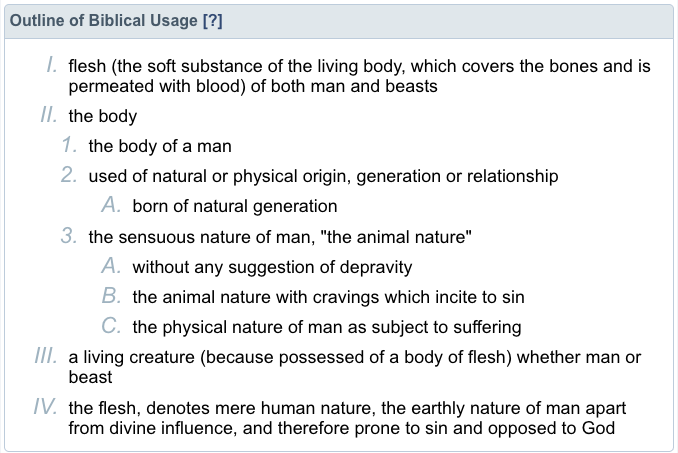
When we hear "flesh" in English, we usually just think of skin and bones. But if we do a word study on the Greek word sarx in the New Testament, we see it has three senses:
Physical Body (Neutral): In John 1:14, "The Word became flesh." Jesus took on a physical human body.
Human Ancestry (Neutral): In Romans 9:3, Paul talks about his "kinsmen according to the flesh." (His biological Jewish relatives).
The Sinful Nature (Negative): In Galatians 5:17, Paul says, "The desires of the flesh are against the Spirit." Here, it means the rebellious, anti-God desires inside of us.
If we don't survey these verses, we fall into the "Backpack Fallacy." If we take the Galatians definition (Sinful Nature) and dump it into John 1:14, we accidentally claim that Jesus became a "sinful, rebellious creature." Surveying the semantic range protects the doctrine of the Incarnation. And the good news is you can do this well with just your English Bibles.
Conclusion
The goal of a word study is not to find a "secret, hidden meaning.” The goal is clarity. When we realize that words are complex and context-dependent, we stop using the Bible as a mirror for our own clever ideas and start honoring God’s Word and taking every word seriously. This does not mean we all have to become Greek and Hebrew scholars, but whenever we are depending on the meaning of a word to understand the whole passage or even dictate a whole doctrine, we must take these necessary extra steps. This is not something you should do daily, but whenever you are doing a deeper study on a passage.
Below is a tutorial on how to use a free resource called Blue Letter Bible on how to do this very thing. If you're listening on podcasts, please pull up the blog and see this simple guide on how to use original language word studies to help you understand what words mean.
References:
Carson, D.A. Exegetical Fallacies. Grand Rapids: Baker Academic, 1996, 26.
Duvall, J. Scott, and J. Daniel Hays. Grasping God’s Word. 4th ed. Grand Rapids: Zondervan, 2020, 162.
Fee, Gordon D., and Douglas K. Stuart. How to Read the Bible for All Its Worth. 4th ed. Grand Rapids: Zondervan, 2014, 27.
Carson, Exegetical Fallacies, 60.
Plummer, Robert L. 40 Questions About Interpreting the Bible. Grand Rapids: Kregel Academic, 2010, 130.
Blue Letter Tutorial: A simple Guide to Original Language Word Studies
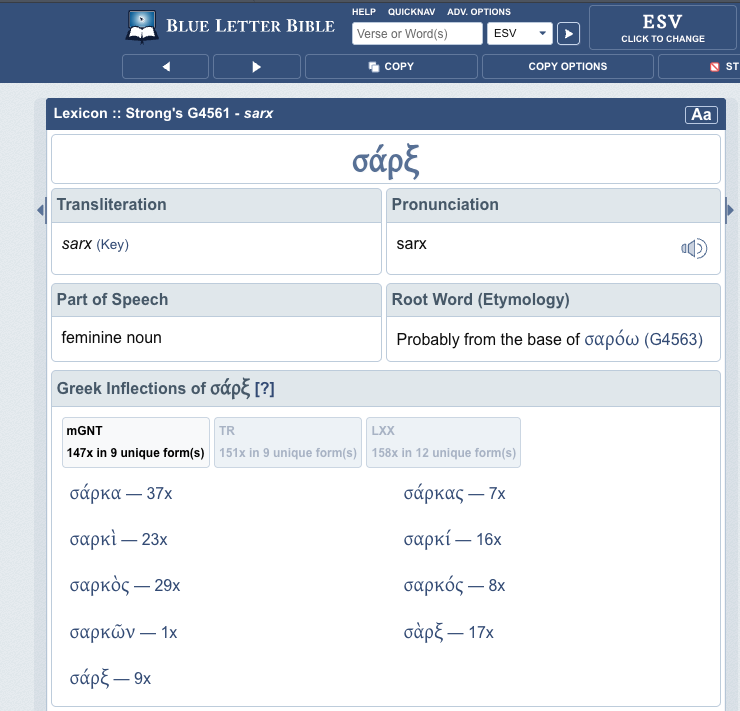
Step 1: Locate the Original Word
Go toBlueLetterBible.org.
Search for John 1:14.
On the left-hand side of verse 14, click the button labeled "Tools." 4. A menu will slide out. Select the "Interlinear" tab.
Look for the English word "flesh." Next to it, you’ll see the Greek word sarx and the Strong’s number G4561. Click that number.
Step 2: Explore the Semantic Range
Once you click the number, you’ll see the "Outline of Biblical Usage." This shows the word's "range"—all the different ways it can be used.
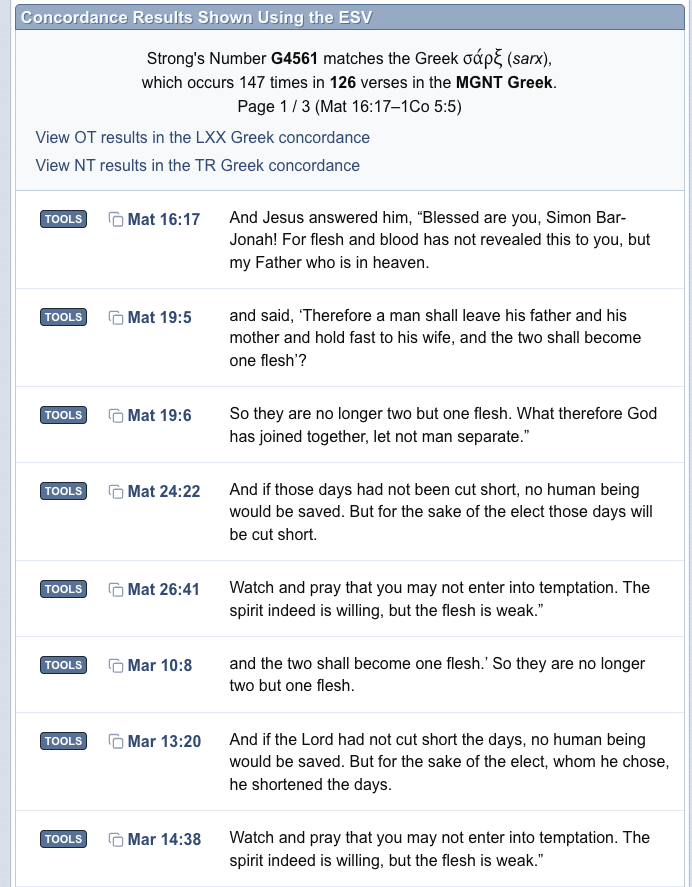
Step 3: Look at all its uses
Reminder Just because a word can mean something doesn't mean it does mean that here.
Scroll down to the "Concordance" at the bottom of the page and see all the uses of the word in other passages. You can now see how that same Greek word is used differently in different areas.
Step 4: Let Context Decide
Return to John 1:14 and see that the context is the "Word" (God) becoming "flesh."
The Goal: John is using the word to show that Jesus became a real, physical human being—not that he became a sinful being.